

Work well under time pressure.
Your organization may not have a time-management problem.
It may have a time-pressure problem.
When deadlines multiply, priorities compete and responsiveness becomes an expectation, teams can become extremely good at moving quickly.
But speed does not always produce better work.
People react before clarifying. Everything becomes a priority. Decisions are made with insufficient thinking time. Messages create urgency for other people. Teams move quickly, and sometimes have to redo what was done too quickly.
The question is not how to eliminate pressure.
It is how to work well when pressure is present.
The I Have Time™ Method helps leaders and teams recognize how time pressure is affecting the way they think, decide, communicate and collaborate—and develop the ability to choose the pace a situation actually requires.
I Have Time™ for Organizations:
workshops, keynotes and tailored interventions
I Have Time™ for Organizations brings the Method into workplaces through interactive workshops, keynotes and strategic team interventions.
The work is designed for organizations that want to look more closely at how urgency, competing priorities and expectations around responsiveness are affecting the way people work together.
Depending on your context, we may focus on:
Decision-making under pressure
Competing priorities and unclear urgency
Communication, responsiveness and expectations
Collaboration when pressure travels through a team
Protecting sufficient thinking space for consequential decisions
Developing a more shared and deliberate approach to pace
The objective is not to remove pressure from working life. It is to improve the organization’s ability to operate within it.
Choose the right I Have Time™ format
Every organization experiences time pressure differently.
A workshop may be the right place to begin. A keynote may open a broader leadership or cultural conversation. A tailored intervention may be useful where the issue needs to be explored beyond a single session.
I Have Time™ Workshop
An interactive workshop for teams and leaders to examine how time pressure is already changing the way they work.
Participants identify their own patterns around urgency, priorities, responsiveness and decision-making, and experiment with practical ways of creating greater clarity under pressure.
Depending on the organization and team, the workshop can explore questions such as:
- What becomes urgent here—and why?
- What happens to our decisions when pressure increases?
- How do we communicate urgency?
- What do we mean when we say “ASAP”?
- What happens when several priorities compete?
- Where would a small amount of thinking space improve the quality of our response?
- How can we become better at choosing when to accelerate and when not to?
Formats: 90-minute introduction, half-day workshop, or tailored team intervention.
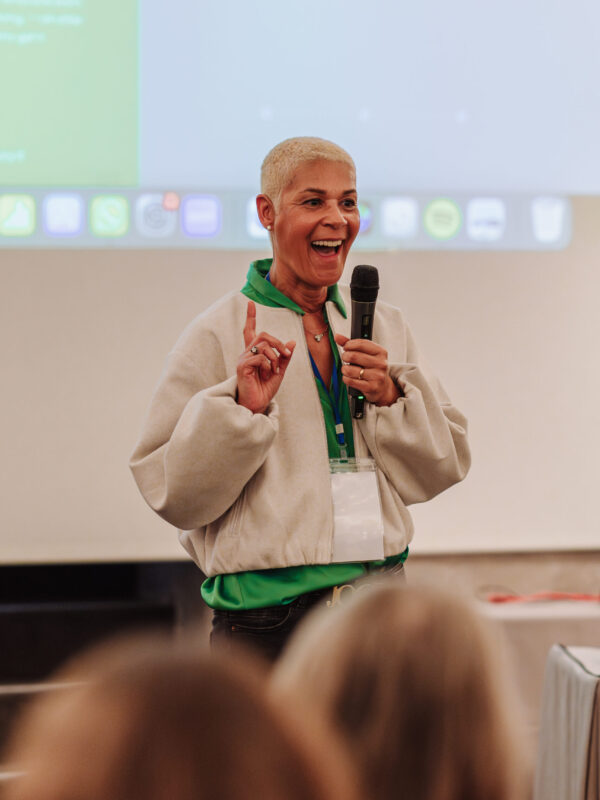

Keynotes and conferences
A keynote or conference exploring one of the defining tensions of contemporary work:
We have become extraordinarily good at saving time, yet increasingly poor at protecting the quality of the time in which we think and decide.
Sandrine introduces the principles behind The New Time Culture™ and the I Have Time™ Method, challenging the assumption that faster necessarily means better.
Designed for leadership meetings, company events, conferences and international audiences.
Strategic team interventions
For organizations that want to explore the issue beyond a single workshop.
These interventions begin with the organization’s real context rather than a generic programme.
Where does unnecessary urgency originate?
How does it travel through the organization?
What behaviours reinforce it?
Where are priorities unclear?
What expectations around responsiveness have become implicit?
What needs to change at team level, and what may require a broader cultural conversation?
The objective is to translate insight into practical changes in the way people decide, communicate and collaborate under pressure.

A starting point
You do not need to know whether your organization “has a time-pressure problem.”
A useful starting point is simply to look for the signals.
Does everything seem important?
Do priorities frequently compete?
Are people expected to be constantly responsive?
Are decisions revisited because they were made too quickly?
Do managers struggle to protect thinking time?
Does “ASAP” mean different things to different people?
Do employees remain mentally at work long after the working day has ended?
If several of these questions feel familiar, there may be something worth examining.
About Sandrine Kom
Sandrine Kom is the founder of the I Have Time™ Method and author of the forthcoming The New Time Culture.
